|
|
There are
hundreds of different birds to view in Delta and Interior Alaska. Below
is a list of some of the birds you can see here.
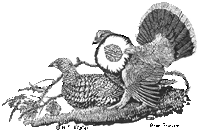
Grouse - are found in the Yukon River Valley from
Canada to Holy Cross, and in the valleys of the Upper Koyukuk, Upper
Kuskokwim, Tanana, and Upper Copper rivers. Fire is important in the
ecology of the sharp-tail, since fire maintains the brushy grasslands
that are one of the preferred habitats. Other rather open vegetation
types are also used, such as spruce bogs, scrubby woodlands, and
birch-aspen parklands.
Ptarmigan - are found nearly everywhere in Alaska’s
high, treeless country. They occupy a broad range throughout Canada,
Scandinavia, Finland and Russia. The famous Red Grouse of Scotland is a
race of the Willow Ptarmigan. Ptarmigan look just like small grouse,
except that their toes are feathered, their wings are white all year,
and they have pure white body plumage in winter.
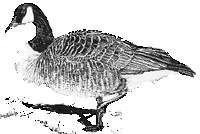 Canada Geese - are the most familiar geese in Alaska
and across North America. They are classified into over 15 subspecies
varying in size and shading. All have a distinctive black head and neck
with a white cheek patch; most have a full or partial white ring at the
base of the neck, brownish wings, back and sides, white to grayish-brown
breast and belly, white rump patch, and black legs and feet. Canada Geese - are the most familiar geese in Alaska
and across North America. They are classified into over 15 subspecies
varying in size and shading. All have a distinctive black head and neck
with a white cheek patch; most have a full or partial white ring at the
base of the neck, brownish wings, back and sides, white to grayish-brown
breast and belly, white rump patch, and black legs and feet.
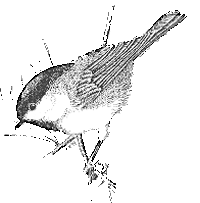
Chickadees - are among the most widely recognized
birds of Alaska forests. Their constant action and agile movements,
combined with their appearance, suggests a perky and cheerful
disposition. We are able to view them closely because they are
relatively tame and easily attracted to feeders. Chickadees are small
songbirds with round bodies, short pointed bills, long tails, black
bibs, and generally conservative gray, brown, black, and white plumage.
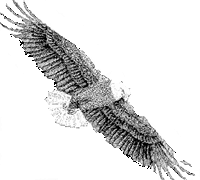
The Bald
Eagles of Alaska’s waterways and the soaring
Golden Eagle of the Interior are two of this state’s most
magnificent birds of prey. Long valued for their aesthetic beauty, eagles are now
recognized for their biological importance as scavengers and predators
in the natural environment. These raptors deserve our protection and
respect.
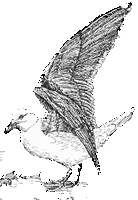
Gulls - Three large gulls are commonly found in
Alaska. These are the glaucous-winged gull, glaucous gull,
and herring gull, in order of decreasing abundance. These gulls
are closely related, and hybrids are not uncommon.
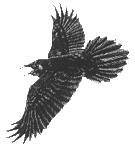 The
Common Raven - is a member of a family of birds known
as the Corvidae, which includes jays, crows, and magpies. The raven is
found throughout most of the Northern Hemisphere in many types of
habitats. The raven is a permanent resident in Alaska, nesting from the
Seward Peninsula and the Brooks Range throughout the mainland, south to
Kodiak Island, throughout the Aleutian Chain and along the coast and
mountains of Southeast Alaska. The
Common Raven - is a member of a family of birds known
as the Corvidae, which includes jays, crows, and magpies. The raven is
found throughout most of the Northern Hemisphere in many types of
habitats. The raven is a permanent resident in Alaska, nesting from the
Seward Peninsula and the Brooks Range throughout the mainland, south to
Kodiak Island, throughout the Aleutian Chain and along the coast and
mountains of Southeast Alaska.
Sparrows - Fifty-one species of birds in the sparrow
and warbler family are known in Alaska. This large and diverse group
also includes the grosbeaks, orioles, blackbirds, tanagers, longspurs,
juncos, and buntings. This notebook series deals with eleven of these
species, those known by the common name “sparrow.” Sparrows are
secretive birds and rarely allow close approach. One good way to
identify them is by learning the distinctive song of each species.
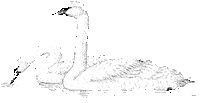 Swans - Trumpeter swans
and tundra swans are the two species of swans native to North
America, both nesting in Alaska. The tundra swan was formerly named the
whistling swan. A few whooper swans, an Asian temperate region
relative to trumpeters, are occasionally seen in the Aleutian Islands
during winter. Swans - Trumpeter swans
and tundra swans are the two species of swans native to North
America, both nesting in Alaska. The tundra swan was formerly named the
whistling swan. A few whooper swans, an Asian temperate region
relative to trumpeters, are occasionally seen in the Aleutian Islands
during winter.
Terns - are slim and graceful waterbirds, quite
similar to gulls. In fact, both gulls and terns belong to the same
family, Laridae, although terns have their own subfamily, Sterninae.
Three species are found in Alaska—the arctic tern, the
Aleutian tern, and the Caspian tern.
Sandhill crane is Alaska's largest game bird.
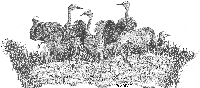 Residents of the
Yukon-Kuskokwim Delta have affectionately nicknamed it the “Sunday
turkey.” In some ways, cranes are birds of great contrasts. They are one
of the most stately and dignified birds in flight, but they can also be
one of the most comical when doing their famous “mating dance.” They
come together in great flocks during migrations but are wary and scatter
widely in their breeding and nesting areas. Residents of the
Yukon-Kuskokwim Delta have affectionately nicknamed it the “Sunday
turkey.” In some ways, cranes are birds of great contrasts. They are one
of the most stately and dignified birds in flight, but they can also be
one of the most comical when doing their famous “mating dance.” They
come together in great flocks during migrations but are wary and scatter
widely in their breeding and nesting areas. |